My son, Cameron, is up for an upgrade to his longtime Verizon Droid phone. He's eying the newest, most powerful Droid Bionic from Motorola. He hesitated for a bit when the iPhone 4S hysteria hit, but this very thorough review by phandroid gives some solid support to moving up to this powerful, awesome Android phone. With a SUPERFAST dual-core processor and I believe it uses Android's Gingerbread OS, this is a phone that definitely takes it up a notch! What do YOU think? Target Mobile has a terrific $219 upgrade price for this phone (not too bad).
Showing posts with label Android. Show all posts
Showing posts with label Android. Show all posts
Monday, October 24, 2011

Friday, July 29, 2011
Apple now No. 1 smartphone vendor by volume
 By Tarmo Virki, Reuters
Apple and Samsung Electronics ended struggling Nokia's 15-year reign at the top of the smartphone sales rankings in the second quarter, researchers said on Friday.
"Apple overtook Nokia and Samsung to become the world’s No. 1 smartphone vendor by volume for the first time in history," said Neil Mawston, analyst at Strategy Analytics.
Nokia has dominated the smartphone market ever since its 1996 launch of the Communicator model, but competition from its two nearest rivals and a slump in its own sales sent it straight from first to third place in the three months to June as growth in the sector starts to slow.
Apple sold a record 20.3 million iPhones in the quarter despite the fact that its iPhone 4 model is now more than a year old. Usually success of smartphone models does not last so long.
Apple unveiled its sales last week, but on Friday analysts also estimated Samsung sold 19 million smartphones in the quarter, well ahead of Nokia's 16.7 million as it was able to benefit from booming demand with smartphones using Google's Android software.
"Samsung's Galaxy portfolio has proven popular, especially the high-tier S2 Android model," said Mawston.
Strategy Analytics estimated smartphone market volume grew 76 percent from a year ago in the second quarter. ABI Research was somewhat more cautious estimating market grew 62 percent.
The Best Android Phones
 By Wendy Sheehan Donnell, PC Magazine
It's hard to believe that it's been just three years since Google's open-source Android mobile operating system hit the scene. When the first Android phone, the T-Mobile G1, was released, the mobile landscape looked very different. Most people carried simple handsets that focused on making calls. If you were lucky, you could listen to music or play games on your mobile phone.
Back then, you didn't have to have a smartphone that ran thousands of apps to let you, in the palm of your hand, do many of the things your computer could do. Apps weren't even a thing yet. Apple had only released the iPhone 3G and launched its groundbreaking App Store a couple of months earlier.
It was the introduction of Android that helped propel the app-based smartphone to what it is today. The thing Android offered, which Apple's iPhone couldn't, was choice. Since it was an open-source platform, several hardware manufacturers could use the OS on their handsets, and a variety of wireless carriers could offer those phones—and they did.
A year after Android was released, in the U.S. there was a single Apple iPhone on a single carrier, but there were eight different Android handsets with varying form factors available on three of the four major carriers. Today, you can find a variety of Android phones on AT&T, Sprint, T-Mobile, and Verizon Wireless. Even the little guys like Cricket and Virgin Mobile offer Android options. According to Comscore, Android enjoys 33 percent of the U.S. smartphone market today.
That's a lot of phones to choose from. To come up with our list, we've chosen two winners for each of the four major carriers, one for each of four smaller carriers, and, if you're contract-phobic, the best unlocked handset. If you've settled on Android as your mobile platform, these phones are your best bets—for now, that is. At this rate of growth, we can assure you that there's another great 'Droid right around the corner.
It was the introduction of Android that helped propel the app-based smartphone to what it is today. The thing Android offered, which Apple's iPhone couldn't, was choice. Since it was an open-source platform, several hardware manufacturers could use the OS on their handsets, and a variety of wireless carriers could offer those phones—and they did.
A year after Android was released, in the U.S. there was a single Apple iPhone on a single carrier, but there were eight different Android handsets with varying form factors available on three of the four major carriers. Today, you can find a variety of Android phones on AT&T, Sprint, T-Mobile, and Verizon Wireless. Even the little guys like Cricket and Virgin Mobile offer Android options. According to Comscore, Android enjoys 33 percent of the U.S. smartphone market today.
That's a lot of phones to choose from. To come up with our list, we've chosen two winners for each of the four major carriers, one for each of four smaller carriers, and, if you're contract-phobic, the best unlocked handset. If you've settled on Android as your mobile platform, these phones are your best bets—for now, that is. At this rate of growth, we can assure you that there's another great 'Droid right around the corner.
Friday, June 24, 2011
iPhone threatens Android rule
 iPhone threatens Android rule
As the iPhone starts to proliferate on other carriers after being released from AT&T's exclusive hold, it threatens to encroach upon the once-comfy rule Android phones have enjoyed in the smartphone market.
One analyst, Needham & Co.'s Charlie Wolf, says that a recent decline of Android's market share in the U.S. — from 52.4 percent to 49.5 percent in first quarter of 2011 — signals the beginning of the end of the Google mobile operating system's unrivaled ascent to the top of the smartphone heap.
GigaOM's Ryan Kim quoted from Needham's note, which points to a possible surge in iPhone 5 sales once the new model arrives this fall on Verizon.
In a report released in May, the addition of the iPhone to the Verizon network accounted for a boost in sales for Apple (16.9 million iPhones sold to fanboys and girls in 90 countries, doubling its sales from the same time last year), but Android held onto the No.1 spot at 36 percent of the market share worldwide.
In just a few short years, we've seen Android — with its prolific installment on so many models over so many carriers — shoot by leaps and bounds over other systems, until finally it surpassed Symbian for the No.1 spot during the first quarter of 2011.
But faster than a medieval coup — the king is dead, long live the king — it looks like Apple's iOS may be poised to hoist iPhones over the palace walls with big gains in the first quarter of 2011 (29.5 percent, up from 17.2 percent in the previous quarter), and with the iOs bumping up from 19 percent to 28 percent (thanks to CNN Money's Philip Elmer-DeWitt for providing more snippets from Needham's note).
More reason to think that Apple may very well overtake Google: cheaper iPhones? That's what GigaOM's Kim writes, and that would make for some interesting jousts since Android phones have historically been more accessible to the more cost-conscious consumer.
Still sliding: Nokia and Research in Motion (which recently started issuing pink slips), which bolsters the reality that the smartphone wars are really between Apple and Google at this point.
Sunday, May 29, 2011
10 Androids That Outmuscle the iPhone
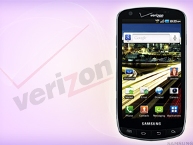 10 Androids That Outmuscle the iPhone - Yahoo! Shopping: "Apple's iPhone had a good run atop the smartphone league, but 10 Google Androids aim to bury the tuckered-out leader this year.
Motorola Mobility, Samsung, HTC and LG have promised to deliver supercharged, ultra-thin, 4G Android devices in the coming weeks and months.
But not always. Before the mobile phone industry got all busy with design makeovers and tummy tucks, there were -- and still are -- some delightfully hideous phones that represented the other side of the beauty trend. The Street has gone back through the past decade to dig up some of the best examples of designs that make you wince and stare in disbelief. The clueless stylings, the flights of fancy into odd shapes, the obsession with square versus rounded -- it is a wonderfully colorful history.
The giant Android attack features bigger screens, better cameras, faster processors and speedier 4G connections than the upcoming iPhone.
The Android's phone screens, for example, start at 4 inches and go to 4.5 inches, advancing the size standard for this generation of touchscreens. By comparison, Apple's next iPhone is expected to have a 3.5-inch screen.
The new Androids are 4G phones either on AT&T HSDPA-Plus network or Verizon's LTE network, and four of the 10 will come with dual core processors.
Apple, on the other hand, is expected to upgrade to a dual-core processor this year, but the 4G LTE iPhone has been delayed to 2012, as first reported.
The presumed delay of the next iPhone from June to September, and the decision to wait a year on 4G LTE upgrade highlight just a few of the areas where Apple has been lagging behind the leaders in the Android pack.
'The processor and display quality improvement in the Android camp is proceeding at such a clip that Apple will be under a lot of pressure to deliver a substantial jump in iPhone specs next autumn,' MKM Partners' analyst Tero Kuittinen.
'It's not clear how Apple can battle the rapid Android evolution,' says Kuittinen, 'unless it picks up the pace of its iPhone launches.'
- Sent using Google Toolbar"
Sunday, May 1, 2011
Android to get video chat via Google Talk upgrade
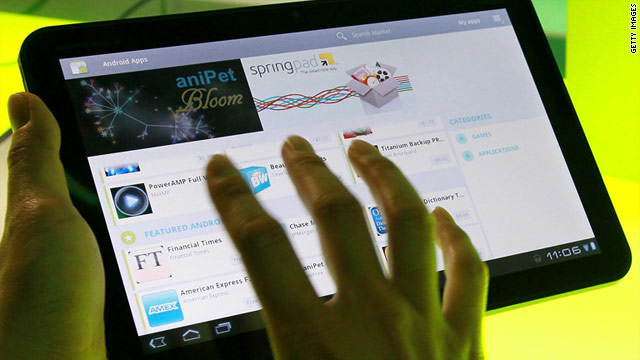 Android to get video chat via Google Talk upgrade - CNN.com: "Google is beginning its rollout of Google Talk video chat to Android devices.
Android device users will be able to use video and voice chat with any Google Talk contact using another Android devices (phones or tablets) or Google Talk on Gmail. The features will work of standard 3G, 4G and Wi-Fi connections.
According to the Google Mobile blog, these features are rolling out to Nexus S phones over the next few weeks along with the next over-the-air OS update. Video chat via Google Talk will be available on other Android 2.3 and higher devices soon.
Using the new features is simple. On your Android device, from the Google Talk contacts list, you'll see a video and voice chat icon next to each contact. Touch the button for the feature you'd like to use, and chat away.
Video can be paused while audio chat continues if you need to navigate elsewhere during a video session. During voice or video chat, text chats from that contact are overlaid on the device screen.
Video and voice chat first came to Gmail late in 2008 and to iGoogle in 2009.
See the original article at Mashable.com.
- Sent using Google Toolbar"
Thursday, April 21, 2011
RIM PlayBook sells 50,000 on Day One; Amazon tablet (probably) imminent
 CLICK HERE to read full article
"Research in Motion’s (RIMM) new tablet, the Android app-compatible PlayBook, hit the streets this week. It also sold better on its first day of shelf life than many expected, moving 50,000 tabs on April 19.
Here’s a quote from MSNBC.com’s Gadgetbox on the subject from its story:
‘The launch appears to have been stronger than the launch of Motorola's Xoom [Android] Tablet, or the Samsung Galaxy Tab, although it's too early to judge sustainability,’ said RBC Capital Markets' analyst Mike Abramsky in a note to clients.
Of course, the PlayBook’s numbers aren’t exactly comparable to what Apple’s iPad pulled down -- 300,000 sold on its first day in April 2010, 19.5 million iPads and iPad 2s sold to date -- but in the increasingly crowded tablet market, it’s not a bad showing, especially given the fact that RIM has been struggling to catch up with Apple (AAPL) and Google (GOOG) of late. Abramsky told the Montreal Gazette that RIM is on track to ship 500,000 PlayBooks by the first quarter of 2012.
- Sent using Google Toolbar"
Friday, March 25, 2011
To take on Apple, new tablets go where iPad won't
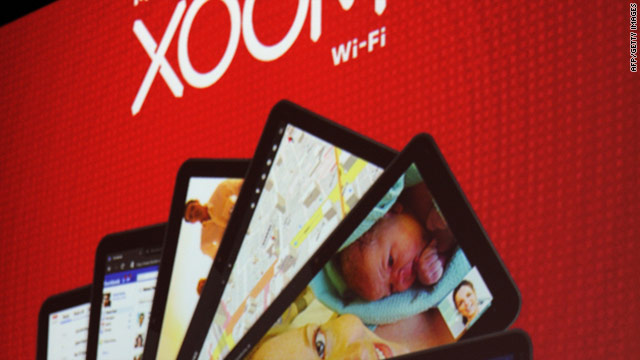 To take on Apple, new tablets go where iPad won't - CNN.com: "Electronics manufacturers have all the pieces they need to create a great competitor to the iPad.
The challenge may be figuring out which technology gives them the greatest strategic advantage.
Whether it's using the fastest 4G cellular chips, myriad screen size options, 3-D viewing, 3-D image capture or those retro stylus pens, tablet makers are hoping to mine a niche that Apple is ignoring.
When it comes to tablets, Apple doesn't have the vast technological lead it had in touchscreen smartphones when it introduced the iPhone in 2007.
When rival phone makers finally caught up years later, they were able to outflank Apple somewhat by offering similar products on cellular networks, such as Verizon, where Apple was not.
But the iPad 2, which went on sale two weeks ago, is available on the two largest carriers. Apple also has a significant lead in software, with more than 60,000 applications tailored to the iPad. Google's tablet operating system, called Android Honeycomb, has only a few because it's so new.
So competitors aim to flood the tablet industry -- and smother Apple -- with new choices.
- Sent using Google Toolbar"
Thursday, March 10, 2011
SHOW #100 - NerdBoyTV: Android NOOK Color
In this episode of NerdBoyTV, Ryan Yee shares how some people are getting around the high cost of Android tablets by converting their NOOK Color e-readers into touchscreen tablets with full access to the Android App Market.
Sunday, March 6, 2011
Nook Color Android hacks are being sold on eBay
 By Crave - CNET
"Hacking or rooting the Barnes & Noble Nook Color has become a commercial venture for some, and that has plenty of Android enthusiasts calling foul.
In recent days folks on eBay have started selling hacks for the Nook Color pre-installed on microSD cards, which start around $60 for 4GB cards and work their way upwards. Installing one of the cards in the Nook Color's microSD slot allows users to override Barnes & Noble's 'closed' Android-based Nook firmware with an open Android system that supports running a multitude of Android apps. 'Modders' have been 'porting' various 'rooted' versions of the Android OS to the Nook Color, including a preview version of Honeycomb (Android 3.0), which is designed for tablets. This has made the affordable though slightly underpowered Nook Color ($250) a popular item with Android enthusiasts who don't want to shell out bigger money for true Android tablets like the $799 Motorola Xoom.
Over at the Android Police Will Shanklin was dismayed at the turn of events. He urged readers not to pay money for a Nook Color SD card that runs Honeycomb.
- Sent using Google Toolbar"
Friday, March 4, 2011
Android and iPhone: It's a two-horse race
 Courtesy of Technolog (CLICK to read more)
"It's official — there are only two mobile operating systems that matter right now. Even as underdog competitors march onto the field trumpeting enthusiastic comeback strategies, the big money is on Apple's iOS and Google's Android, the Mac and PC of the 21st century.
No matter how much enthusiasm HP and Microsoft can drum up, their product lines are years behind the competition, and they currently sit on extremely minuscule market shares. Microsoft might get a big push from Nokia, but their joint products won't even come to market until 2012. Meanwhile RIM, former big cheese, is seeing its BlackBerry fortune fall fast. Though the PlayBook tablet may be the company's first buzz-worthy gadget in years, it comes with a strange requirement: To get full functionality out of it, you have to already use a BlackBerry. Preach to the choir much, RIM?
By contrast, Apple and Google are hustling to reach new customers. The Android camp wants to get into the iPad business that, with over 14 million in sales in just 8 months, Apple proved to be viable. In the phone business, Apple is fighting to gain back its lead from Google. Not only is Apple finally supplying iPhones to a second U.S. carrier — doubling its potential American customer base to roughly 190 million — but it's rumored to be devising a cheaper iPhone that addresses Android's best asset: its relative cheapness.
The main reason why these two will stay on top is half a million mobile apps, and counting."
Monday, February 21, 2011
Motorola Xoom Available for Pre-Order at Best Buy for $800
 By Yahoo! News: "We knew the price for Motorola's upcoming Android tablet, the Xoom, would be $800, but seeing the price on a live Best Buy pre-order page turns this haunting mental image into harsh reality.
You can pre-order the Xoom, which currently comes in only one flavor, now and pick it up Thursday, February 24, in Best Buy stores.
The Xoom is one of the first tablets on the market to run Android 3.0 or Honeycomb, the first version of Android designed specifically for tablets. It sports impressive features: a 10.1'' widescreen HD display, a 1 GHz dual-core CPU, as well as Wi-Fi and 3G support. Add to that the 5-megapixel camera on the rear and a 2-megapixel one on the front, as well as the accelerometer and HDMI output, and you might even be able to justify the price tag.
Besides the Xoom itself, Best Buy also offers several accessories, including a $70 Bluetooth wireless keyboard, a $130 speaker dock, and a $40 portfolio-style case.
- Sent using Google Toolbar"
Friday, February 4, 2011
Google unveils Android tablet, takes aim at Apple
This week, Google showed off the latest version of its Android mobile operating system, Honeycomb.
Visit msnbc.com for breaking news, world news, and news about the economy
Tuesday, February 1, 2011
What should we expect from Android’s Gingerbread and Honeycomb updates?
 Marty Gabel | Appolicious ™ Android App Directory: "Cupcake. Donut. Eclair. Froyo. What’s up next? Why, it’s Gingerbread and Honeycomb of course. These future Google Android updates may posses sweet nicknames, but they also pack a lot of power and continue to improve the still quite youthful Android operating system, hopefully adding both function and performance.
When can we expect these updates? A lot depends on the mobile carriers and the device manufacturers themselves. With a huge number of devices (both smartphones and tablets) on different networks, some old, some new, there’s no uniform rollout like Apple iPhone users see. You take your chances with the device you buy, and the staggered rollout of these updates continues to be a large bone of contention with many Android owners.
Still, there’s plenty of information on what we can expect from the forthcoming updates. We’re just not sure when they’re going to drop. Let’s take a look at some of the new functionality, features, and improvements we hope to see when Gingerbread and Honeycomb finally get unleashed.
- Sent using Google Toolbar"
Android smartphones, tablets on the march
 Android smartphones, tablets on the march - Yahoo! News: "Just a year ago, Android handsets accounted for a slim 8.7 percent of the global smartphone market, with OS vendors such as Nokia, RIM, and Apple well in the lead, according to an industry survey. Not anymore. Also: Android establishes a beachhead in the tablet market.
We've already been hearing plenty of reports about how Google's Android OS has been surging in the domestic and worldwide smartphone marketplaces, but the latest figures from the industry analysts at Canalys put the new mobile platform landscape on stark perspective, with Android sales seeing an extraordinary, 615-percent growth spurt in 2010 to topple Nokia's Symbian platform off its throne.
As of the end of the fourth quarter last year, Android enjoyed a 33.3 percent share of the global smartphone market, according to Canalys, with Nokia's Symbian OS trailing (just barely) at 31 percent.
Mind you, Nokia still ranks as the No. 1 global manufacturer of smartphones, the survey noted, with the Finnish phone giant seeing worldwide shipments of its smart handsets grow 30 percent in 12 months.
But that wasn't enough to stop Android, which saw its global market share kick in the afterburners with help from a veritable gang of smartphone makers—think HTC, Samsung, LG, and Acer, according to Canalys.
After Nokia comes Apple, which saw its fourth-quarter 2010 global iOS market share dip ever so slightly to 16.2 percent, from 16.3 percent in the fourth quarter of 2009—although as with Nokia, Apple still saw a healthy surge in global sales (up nearly 86 percent compared to the fourth quarter of '08).
In fourth place, we've got BlackBerry maker RIM with 14.6 percent of the global smartphone market, down more than five percent from the year-ago 2009 period, while Microsoft saw its fourth-quarter 2010 market share slump to 3.1 percent.
- Sent using Google Toolbar"
Saturday, January 8, 2011
Tablets crowd gadget show, chasing iPad's tail
 Tablets crowd gadget show, chasing iPad's tail - Yahoo! News: "Big tablets and small tablets, white ones and black ones. Cheap ones and expensive ones. Brand names famous and obscure at the starting line of a race where the iPad is already a speeding dot near the horizon.
It's impossible to walk the floor at this year's International Consumer Electronics Show without stumbling across a multitude of keyboard-less touch-screen computers expected to hit the market in the coming months. With Apple estimated to have sold more than 13 million iPads last year alone, the competition is clearly for second place, but even that prize is worth pursuing.
Technology research firm Gartner Inc. expects that 55 million tablet computers will be shipped this year, most of them still iPads, but there will be room for rivals to vie for sales of the remaining 10 million to 15 million devices.
A bevy of consumer electronics makers, including major names such as Motorola Mobility Inc., Toshiba Corp. and Dell Inc., showed off their tablets in Las Vegas at CES, betting 2011 will be the year the gadgets finally take off.
Companies tried for years to popularize tablets, but the frenzy began only with the release of the iPad in April. Now companies whose names don't include the word 'Apple' are doing everything they can to differentiate themselves from the tablet front-runner.
They're adding bells and whistles the iPad doesn't yet have — such as front and back cameras for video chatting and picture taking and the ability to work over next-generation 4G data networks — in hopes of taking on the iPad, or at least carving out a niche.
- Sent using Google Toolbar"
Wednesday, January 5, 2011
Motorola Xoom Android tablet may be first iPad killer
 Technolog - Motorola Xoom Android tablet may be first iPad killer: "Though there have been tablets running Android on the market since last year, the Motorola Xoom, debuted today at CES in Las Vegas for the very first time, represents the first real Android tablet sanctioned by Google, running an operating system designed explicitly for tablets. Forget the Samsung Galaxy Tab, forget it completely. This is Google's first attempt to take on the iPad, and it's a worthy one.
The device has a 10-inch widescreen display and is actually a hair thinner than an iPad: Xoom measures 12.9mm at the middle while the iPad measures 13.4 mm. It's a smooth black on black with a rubberized rear. It has two cameras, one in front for videoconferencing, one in back for shooting. Battery life is about 10 hours for video, which should put it in the same company as the iPad. Meanwhile, its 1280x800 display is 16:10, which means it uses almost the entire screen when playing a movie."
Saturday, January 1, 2011
10 Must-Have Android Apps
 10 Must-Have Android Apps | PCMag.com: "A few days ago, I was showing my girlfriend, an iPhone 4 owner, something on my Android-based Sprint Epic 4G. 'Wow,' she said, 'You have a lot of apps.' I responded casually, but with a certain about of nonchalant geek pride: 'Yes, yes I do.'
Indeed, my dogged pursuit of cool apps is a big reason why I sold my Palm Pre back to Sprint and switched to the Android platform a few months back. Although the number still can't quite match the abundance of Apple's App Store, the Android market is chock full of great applications. But with thousands to choose from, where do you start? Start with these 10 must-have Android apps and you can't go wrong. I promise.
Before we get to them, however, I have to mention a few of my favorite apps that I had to leave off the list. The most obvious omission is Angry Birds. It's a must-have download, to be sure, but at this point, I have to assume you have already heard of it. Everyone has, so there isn't much value in including it here. I also left out both the official Twitter client and TweetDeck. I'm a big Twitter user (@dancosta), but the truth is, most people probably don't need to Tweet from their phone. And those that do already know to download the client.
Likewise, I couldn't get the excellent Photoshop Express into this story. More and more people are using their phones as their primary point and shoot, but I don't think most people are up for in-phone editing just yet. If you're a power user, go for it, but this story is for the newbies. And if you're just starting to download Android apps, these are the first 10 you should get...in my humble opinion, anyway.
- Sent using Google Toolbar"
Saturday, December 25, 2010
A brief history of Android phones
 CLICK to see list on CNET Blogs: "More than two years after the birth of the T-Mobile G1, the world's first Android smartphone, we pause to take a look back at what the little green dude has given us. Frankly, we were a little floored when we assembled all the U.S. handset releases into one list. Sure, we've known that the OS has been very busy, particularity in the last year, but we really had no idea just how busy it was. And if we expanded the list beyond handsets not with U.S. carriers, it would be even longer.
Remember that it wasn't so long ago when Android was just a concept. And not long before that, the only android we knew was Data on 'Star Trek.' But now as its market share continues to grow and the OS has landed in the tablet space, Android has emerged as a powerhouse in the mobile space.
Editors' note: This list is current as of December 10, 2010. For brevity's sake, we've focused only on models sold by U.S. carriers. We've also included upcoming handsets that carriers have officially announced.
- Sent using Google Toolbar"
Sunday, November 7, 2010
iPhone is No. 1 phone, while Android is No. 1 OS
 CLICK to read article on Technolog
"The best-selling phone in America is the iPhone, according to two different reports. But the same research shows Android is the top-selling OS, and it continues unimpeded in its march to worldwide domination. Meanwhile, BlackBerry's Research In Motion is getting stepped on, and dumb phones — those not blessed with any of the so-called 'smart phone' OSes — may well be headed for extinction. The question is, will Android keep it together at the top, or spread itself too thin?
Selling the top phone — not just smart phone but phonephone — should be good news for Apple. But compared to the quarter that ended a year ago, Apple's market share declined by 21 percent against Android. RIM's share drop is a lot worse, though: It's down 53 percent compared to a year ago.
'Much of Android's quarterly share growth came at the expense of RIM, rather than Apple,' said Ross Rubin, executive director of industry analysis for NPD, in a press release. 'The HTC EVO 4G, Motorola Droid X and other new high-end Android devices have been gaining momentum at carriers that traditionally have been strong RIM distributors, and the recent introduction of the BlackBerry Torch has done little to stem the tide.'
With nobody excited about new BlackBerry products, the best thing RIM can do is lower prices on its older more venerated handsets. Its Curve series, the No. 2 selling phone in the U.S., is listed at several carriers for the low low price of ... free. At least, with a two-year contract.
The iPhone beat another free-ish phone, the LG Cosmos, a messaging phone. As the only non-'smart' phone in NPD's top 5, and one that only got there through heavy-duty subsidies, another message is clear: Dumb phones are dying. But that might just mean more Android-powered phones of modest IQ being handed out for free or next to nothing.
- Sent using Google Toolbar"
Subscribe to:
Posts (Atom)